
Last Updated: July 21, 2020
Up-To-Date Immigration Information
Restrictions On Entry Into the U.S.:
The U.S. has suspended entry for non-U.S. citizens who traveled in the following countries within 14-days:
Austria, Belgium, Brazil, China, Czech Republic, Denmark, Estonia, Finland, France, Germany, Greece, Hungary, Iceland, Italy, Iran, Ireland, Latvia, Liechtenstein, Lithuania, Luxembourg, Malta, Netherlands, Norway, Poland, Portugal, Slovakia, Slovenia, Spain, Sweden, Switzerland, and United Kingdom.
The U.S. land borders between Canada and Mexico are both closed to non-essential foot and car traffic (returning home is allowed; flights continue).
New countries can be added to this list at any time without advance warning.
Visa Issuance:
Most U.S. Embassies and Consulates have suspended regular visa processing for the time being but are allowing emergency visa appointments for students close to their program start date. (March 18, 2020)
ISS Alert: Fall 2020 Immigration Guidance
Tuesday, July 14, as a result of the ongoing lawsuits, SEVP has agreed to rescind their July 6 guidance and July 7 FAQs, and revert back to their prior flexible guidance related to online learning during COVID-19.
Our immigration FAQs are up to date and available below. We held town halls to answer additional questions:
ISS Town Hall - Fall 2020 Update (Continuing Students)
Was held Monday, July 20 8am -9am
ISS Town Hall - Fall 2020 Update (Incoming Grad Students)
Was held Tuesday, July 21 8am -9am
General Questions
ISS Town Hall Slides and Recording
ISS Town Hall: Fall 2020 Update
These links require you to be logged into your SCU Google account.
- Continuing Students Fall 2020 Update Slides
- Continuing Students Fall 2020 Update Recording
- Incoming (Admitted) Students Fall 2020 Update Slides
- Incoming (Admitted) Students Fall 2020 Update Recording (will be posted after July 21)
On July 14, 2020, SEVP as a result of the ongoing lawsuits, SEVP has agreed to rescind their July 6 guidance and July 7 FAQs, and revert back to their prior flexible guidance related to online learning during COVID-19. Our prior town halls discussing the July 6 SEVP guidance on this are no longer relevant and have been removed.
ISS Town Hall: Spring 2020 Social and Academic Life During Shelter in Place (Wednesday, April 29, 2-4pm PST)
These links require you to be logged into your SCU Google account.
Is the Global Engagement Office open? Is the ISS team still working?
Santa Clara County, including Santa Clara University, has asked that people "shelter in place" starting on March 17, 2020. During this time the ISS Team is working remotely from their homes. We're providing additional information about our continued services below:
Email Response
- Our office will continue to respond promptly to emails.
- Emailing iss@scu.edu is the best way to reach us and get answers to your questions.
Drop In Hours
- Drop in hours have moved online!
- Select a Zoom meeting to talk with an advisor via phone or video call (check back for appointments tomorrow 03/17 after 12pm)
- Drop-in will be held during the normal hours (Mon/Tue 2 PM - 4 PM | Wed/Thu 10 AM - 12 PM Pacific Standard Time)
- If you are not available at these times, email iss@scu.edu to request an appointment.
Withdraw / Leave of Absence
- If you plan to leave the U.S. and withdraw or take a leave of absence for the Spring 2020 academic term, please email iss@scu.edu. In the email please include your full legal name, SCU ID number, academic program, and date of departure from the U.S.
- If you have questions about withdrawing or taking a leave of absence, please email iss@scu.edu.
Reduced Course Load & Thesis/Capstone Authorization
- We will continue to process Reduced Course Load (RCL) and Thesis/Capstone authorization requests.
- Please email your completed RCL or Thesis/Capstone Confirmation to iss@scu.edu.
CPT Authorization
- We will continue to process CPT authorization requests.
- To request CPT, please email your completed CPT Cooperative Agreement to iss@scu.edu.
- If you have CPT authorization currently you may work remotely. Be sure to remain in close contact with your supervisor. You do not need to notify our office about this temporary change.
OPT Appointments
- OPT appointments have resumed via Zoom appointment.
- Information on the modified OPT process can be found at scu.edu/opt
- You must be in the U.S. to apply for OPT -- if you are graduating in Winter or Spring, we do not recommend leaving the U.S.
- If you have questions about OPT please email iss@scu.edu
Workshops / Events
- In-person workshops and events are cancelled through the end of Spring and have been removed from our event calendar (scu.edu/geoevents)
- Videos of our workshops are available online (scu.edu/cpt, scu.edu/opt, scu.edu/stemopt)
Will ISS accept electronic signatures on forms?
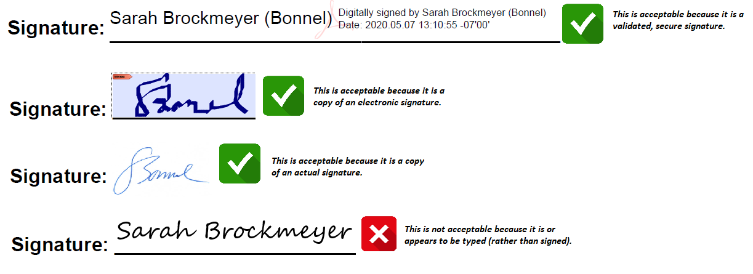
We will accept verified electronic signatures on all ISS forms.
If you opt for the electronic signature, the signature must have a verification mark or be an signature. Typed signatures or signatures with a typed appearance are not accepted. Programs such as DocuSign or Adobe Sign have signature validation features. Please see below for examples.
Electronic I-20s: While the Student and Exchange Visitor Program (SEVP) announced that I-20s can be electronically signed, we do not have clear guidance on whether other government agencies which are not within SEVP's jurisdiction, such as Department of State for visa appointments and Customs and Border Protection for entering the U.S., will accept electronic signatures. Therefore, ISS is not issuing I-20s with electronic signatures at this time.
OPT applications: Your OPT I-20 and Form I-765 must be hand signed prior to mailing your OPT application to USCIS.
STEM OPT extension applications: Your I-983 training Plan can be either hand signed or we will accept verified electronic signatures. Your STEM OPT I-20 and Form I-765 must be hand signed prior to mailing your STEM OPT extension application to USCIS.
How does Trump’s Executive Order “suspending immigration” impact students?
The temporary suspension will not impact SCU’s current or admitted students or scholars. The suspension applies only to people outside the U.S. applying for "immigrant" visas, also known as green card applications. The suspension does not apply to "non-immigrant" visas, such as F-1 students, J-1 exchange visitors or work visas.
If you have any questions, please do not hesitate to contact iss@scu.edu or schedule a drop-in advising appointment.
The history of this Executive Order:
- On Monday April 20, 2020 Trump tweeted that he would be issuing an executive order to “temporarily suspend immigration to the United States”.
- On Tuesday, April 21, 2020 he clarified at a press conference that the executive order would be directed at immigrant visas (i.e. Lawful Permanent Residence, or “green card” applications) not non-immigrant visas.
- On Wednesday, April 22, 2020 the Executive Order was signed.
- On Thursday April 23, 2020 at 11:59pm the Executive Order goes into effect.
What is the history of COVID-19 related travel restrictions?
- China: Sunday, February 2, 2020 at 5:00pm (EST), the U.S. government suspended entry for non-U.S. citizens who traveled in China within 14-days.
- Iran: Monday, March 2, 2020 at 5:00pm (EST), the U.S. government suspended entry for non-U.S. citizens who traveled in Iran within 14-days.
- European Countries: Friday, March 13, 2020 at 11:59pm (EST), the U.S. government suspended entry for non-U.S. citizens who traveled in the Schengen Area within 14-days. The Schengen Area includes the following countries: Austria, Belgium, Czech Republic, Denmark, Estonia, Finland, France, Germany, Greece, Hungary, Iceland, Italy, Latvia, Liechtenstein, Lithuania, Luxembourg, Malta, Netherlands, Norway, Poland, Portugal, Slovakia, Slovenia, Spain, Sweden, and Switzerland.
- Ireland and U.K.: Monday, March 16, 2020 at 11:59pm (EST): the U.S. government suspended entry for non-U.S. citizens who traveled in Ireland or the United Kingdom (Britan, Scotland, Wales, Northern Ireland) within 14-days.
- Brazil: Tuesday, May 26, 2020 at 11:59 EDT: the U.S. government suspended entry for non-U.S. citizens who traveled in Brazil within 14-days
New countries can be added to this list at any time without advance warning.
How are the COVID-19 travel restrictions related to the Presidential Travel Bans?
The COVID-19 travel restrictions are based on recommendations from the U.S. Department of Health and Human Services, including the Center for Disease Control (CDC). They are evaluated regularly (usually every 15 days).
The Presidential Travel Bans are based on immigration policy and the recommendations of the U.S. Department of Homeland Security. They are re-evaluated less regularly (usually every 180 days). You can read more about the Presidential Travel Bans here.
Incoming International Students
We’re excited to welcome you to the SCU international family! We are still issuing I-20s and supporting visa applications for all incoming students.
Santa Clara University is carefully monitoring guidance related to health and safety. You can read updates from the university here.
Please select the button below that corresponds to your academic program for detailed and up-to-date answers to common immigration questions. Our immigration FAQs will be updated if there are any changes to your academic program plans for Fall 2020.
Please contact International Students and Scholars in Global Engagement at iss@scu.edu if you have any additional questions.
Continuing International Students
Santa Clara University is carefully monitoring guidance related to health and safety. You can .
Please select the button below that corresponds to your academic program for detailed and up-to-date answers to common immigration questions. Our immigration FAQs will be updated if there are any changes to your academic program plans for Fall 2020.
Please contact International Students and Scholars in Global Engagement at iss@scu.edu if you have any additional questions.
International Students Who Are Graduating
What is ISS doing to support OPT?
- OPT appointments have resumed via Zoom.
- Information on the modified OPT process can be found at
- You must be in the U.S. to apply for OPT -- if you are graduating in Winter or Spring, we do not recommend leaving the U.S.
- If you have questions about OPT please email iss@scu.edu
I want to apply for OPT. Can I travel?
You must be physically present in the U.S. to apply for OPT. You cannot apply from abroad -- this is a regulation not an SCU policy. If you have already left the U.S. and have not yet applied for OPT, you would need to return to the U.S. before the end of spring term to apply for OPT.
If you’ve already mailed your OPT application, you’re welcome to depart the U.S. but make sure that the mailing address that you listed on your I-765 is still valid and being checked daily.
I am graduating soon. I am concerned that I will not be able to return to my country.
During the 60 day departure period after graduation, international students are eligible to:
- Apply for OPT (scu.edu/opt) -- you can actually do this before graduation, and we recommend you do so now!
- Enroll in a higher degree program at SCU (you must be admitted and have your SEVIS record updated within the 60 days; you must start classes within 5 months)
- Enroll in a new academic program at another school (you must be admitted and have your SEVIS record transferred within the 60 days; you must start classes within 5 months)
- File an application to change your immigration status with USCIS
- Depart from the U.S.
If you have concerns or want to discuss your options further, please email iss@scu.edu or schedule a drop-in appointment.
International Alumni (on OPT and STEM OPT Extension)
I am working remotely due to COVID-19. Do I need to report this?
If you have OPT or STEM OPT Extension authorization you may work remotely during any shelter-in place, stay at home orders, or at the direction of your company.
While working from home you should be sure to remain in close contact with your supervisor.
You do not need to notify our office about this temporary change.
I've been furloughed or laid off, how does this impact my OPT or STEM OPT unemployment calculation?
Companies use the words furlough and lay-off to mean different things. It’s important to speak with your company’s Human Resources (HR) team to understand the status of your job before reporting changes to your employment to ISS.
If a student is laid-off, it means that the company no longer has employment for you and if you want to work for the company again you would have to reapply. If you are laid-off, you are considered unemployed for OPT or STEM OPT unemployment clock purposes and you need to report the unemployment to our office. If you are laid-off you may be eligible for unemployment insurance while you look for a new job.
If a student is placed on a temporary leave or furlough, it means that the company has temporarily suspended your employment due to lack of work or financial trouble, but you are expected to resume your employment with the company as soon as they resume operations. The key here is that you have a job to return to. Sometimes this suspension of employment is a few days or weeks, sometimes it is months. If you are on a temporary leave (or furlough), you are not considered unemployed for OPT or STEM OPT unemployment clock purposes and do not need to report the unpaid leave or furlough days to our office. You should keep documentation from your company (usually a letter from HR or your supervisor) that documents that this leave is in accordance with the company’s policies and that you are expected to resume work. If you are on a temporary leave, you may be eligible for unemployment insurance while you look for a new job or wait for your job to resume. Accepting unemployment does not impact your OPT or STEM OPT unemployment clock.
If you have questions or are not sure how this applies to you, first reach out to your supervisor or company’s Human Resources (HR) team. Once you have written communication from them you can schedule a drop-in appointment with our team.
I've been furloughed or laid off. Am I eligible for State Unemployment Insurance?
Each state has their own process related to unemployment insurance (which is a financial payment for unemployed workers).
If you've been furloughed or laid off, your company should be able to provide you information for the correct state agency and details on the application process.
You can learn more about California's process and eligibility requirements here.
Am I eligible for the Economic Impact Payments / the CARES Act?
To be eligible for the Economic Impact Payments from the CARES Act, you must be a "resident alien for tax purposes”.
Most of SCU's international students and scholars are "non-resident aliens for tax purposes" and are therefore not eligible for the Economic Impact Payments from the CARES Act.
We cannot provide personalized tax guidance, however, you can find tax related information and resources here. We hope these web resources are helpful to you.
Am I allowed to accept unemployment or economic impact payments? How does this relate to the Public Charge Rule?
Both state unemployment insurance payments as well as the economic impact payments are considered "earned benefits", and therefore are not considered a violation of the public charge rule. If you are eligible for these benefits, you may claim them.
Should I travel internationally (outside the U.S.) while on OPT or STEM OPT Extension?
Most companies are discouraging travel (both internationally and domestic) for non-essential purposes.
If you've considered the risk of international travel and still plan to leave the U.S. please review our travel website for a list of documents that you should carry with you.
There is no limitation to the amount of time you can be outside the U.S. while on OPT or STEM OPT extension, however, if you will be outside the U.S. for more than 30 days you should carry documents from your company approving your vacation or remote work from abroad.
STEM OPT Extensions: You must be physically present in the U.S. to apply for a STEM OPT extension. You cannot apply from abroad -- this is a regulation not an SCU policy. Students who have OPT that expires should not leave the U.S. until their STEM OPT extension has been properly delivered to USCIS.
My practical training (OPT / STEM OPT extension) expires soon. I am concerned that I will not be able to return to my country within 60 days.
If you are eligible, you should file a STEM OPT extension. More information can be found at scu.edu/stemopt.
If you are not eligible for further practical training extension, during the 60 day departure period after your practical training period ends, you are eligible to:
- Enroll in a higher degree program at SCU (you must be admitted and have your SEVIS record updated within the 60 days; you must start classes within 5 months)
- Enroll in a new academic program at another school (you must be admitted and have your SEVIS record transferred within the 60 days; you must start classes within 5 months)
- File an application to change your immigration status with USCIS
- Depart from the U.S.
If you have concerns or want to discuss your options further, please email iss@scu.edu or schedule a drop-in appointment.
J-1 Research Scholars and Exchange Students
My program ends soon. I am concerned that I will not be able to return to my country within 30 days.
Programs that originally ended in May have been extended by the Department of State to now end in July -- this means you have until August to depart the U.S. Please check your email for more information.
Prior to the end of your program, please contact iss@scu.edu (students) or scholars@scu.edu (professors / researchers) for guidance. You may be eligible to:
- Extend your program within the U.S. (must be prior to your program end date)
- File an application to change your immigration status with USCIS
- Leave the U.S.
Is it still possible to host a visiting international scholar for 2020-2021 Academic Year?
We continue to monitor the situation and options and as we better understand the university's academic and operational plan for fall, we will evaluate whether it makes sense for these new scholars to physically arrive at the beginning of fall term as planned or if we recommend they defer their arrival to a later date.
We are accepting and processing International Visitor Proposals for the winter quarter and spring semester 2021. Please submit your propsal to scholars@scu.edu on or before the deadline.
For more information, please visit our scholars page.
Parents and Families
Is my student allowed to stay on campus while classes are online?
Students facing extraordinary circumstances that will require them to remain in on-campus housing must request an exception to live on campus no later than March 20, 2020.
- The form is available on your housing portal via eCampus.
- Look for a button titled “Exception Form” across the top of the Housing landing page.
- All exception requests will be reviewed within 24 hours.
More infomation can be found on the SCU On Campus Living Website