Rose Foundation Supports Clean Water Project on Central Coast  | Through a Rose Foundation grant of $175,000, the Initiative’s Iris Stewart-Frey (Water and Climate Justice program) and the California Rural Legal Assistance, Inc. (CRLA) will advance the human right to clean water in rural, low-income California Central Coast communities. A team in the Water and Climate Justice Lab led by Stewart-Frey and supported by Jake Dialesandro will identify high-nitrate wells and variability in nitrate through a residential well testing program in disadvantaged unincorporated communities, analyzing available and monitored data on contaminants in drinking and residential water, and developing and presenting accessible information to communities. CRLA will provide outreach and education to residents. The Initiative’s Water and Climate Justice Program and CRLA will collaborate with other local community organizations to build community residents’ capacity to understand relevant water quality issues, giving them the tools to participate effectively in public planning processes. and work toward protecting and conserving existing drinking water supplies.
Photo: Paul Hudson |
Youth Organizing and Citizenship  | Jesica Fernández published new works on youth organizing for justice. She was the lead author of an article published in the journal Youth, co-written with Rashida H. Govan (The Aspen Institute), Ben Kirshner and Tafadzwa Tivaringe (University of Colorado), and Roderick Watts (City University of New York Graduate Center), entitled Youth community organizing groups fostering sociopolitical wellbeing: Three healing-oriented values to support activism. The authors drew on qualitative data on youth organizing to define three interconnected values that support well-being among participants, including collectivized care, spiritual activism, and freedom dreaming. Fernández also published a blog post for the Photovoice Worldwide blog and an article in The Community Psychologist on her use of photovoice methods with youth to explore environmental justice issues and hopes for their neighborhood in San José, CA. Fernández also published a blog post for the Decolonial Dialogues website reflecting on three lessons from childhood – about curiosity, imagination, and presence – for enacting a decolonial citizenship praxis. |
Story Map on the Fight for Clean Water on California’s Central Coast 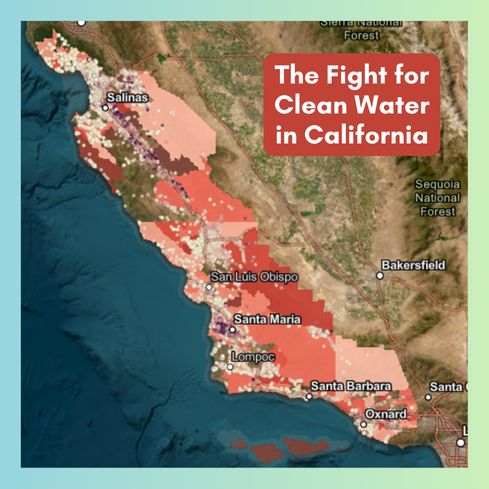 | The Initiative’s Water and Climate Program, and the Water and Climate Justice Lab’s Jake Dialesandro, together with Misión San Lucas, Monterey Waterkeeper, and California Rural Legal Assistance co-published a new story map about the struggle for clean water on the central coast. The story map, which was realized by students Amanda Chong and Christian Thomas Canellos, visualizes nitrate groundwater contamination in the region from overapplication of fertilizer, and its disproportionate impacts on Hispanic/Latinx communities and people in poverty. The site tells a brief history of the issue and offers testimonies from community members about the challenges they are facing. Advocates have asked the U.S. Environmental Protection Agency to investigate the problem as a civil rights issue and to require the California State Water Board to set enforceable limits on fertilizer application and discharge into groundwater to protect public health. |
Environmental Justice Lunch & Learn Seminar at SCU School of Engineering 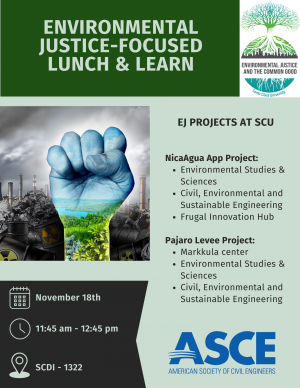 | The Initiative’s Rocio Lilen Segura in partnership with the American Society of Civil Engineers (ASCE) Student Chapter at SCU organized a two-part Lunch & Learn series to emphasize the role of environmental justice (EJ) in engineering. The events showcased real-world applications of EJ principles and offered students insights into how they can contribute to sustainable and equitable solutions. The first Lunch & Learn, held on November 11, featured Roxanne Reimer from the Community Water Center in Watsonville. She shared impactful projects addressing water justice and community resilience. This session aimed to inspire students by showcasing ongoing efforts outside the university, demonstrating the critical role of community-led initiatives in addressing environmental challenges. The second Lunch & Learn, held on November 18, focused on SCU’s interdisciplinary projects that integrate EJ principles into engineering practice. Students learned about two innovative initiatives:
- The NicaAgua Climate App: A climate adaptation tool designed to help communities in Nicaragua tackle pressing environmental challenges and enhance resilience against climate change. Presenters included Iris Stewart-Frey (ESS), Allan Baez Morales (Frugal Innovation Hub), and students Arturo Torres Torres Landa (CSS ’26) and Tanmay Singla, M.S. (CSS ‘24).
- The Pajaro Levee Project: A community-centered initiative addressing flood risk management through the lens of environmental justice. Speakers included David DeCosse (Markkula Center for Applied Ethics), Iris Stewart-Frey (ESS), Rocio L. Segura (CESE), and students Karina Martin (CESE, ’25) and Anna Krebs (CESE, ’25).
|
Podcast and Presentation on Community-Engaged Research for Environmental Justice 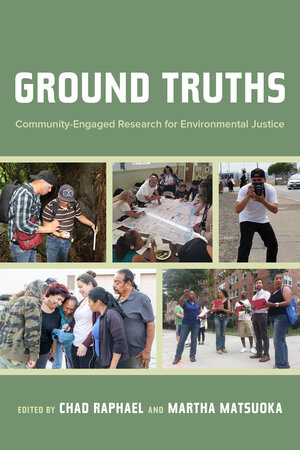 | The Initiative’s Chad Raphael and co-authors Martha Matsuoka (Occidental College) and Ryan Petteway (OHSU-PSU School of Public Health) co-presented chapters of the recent book Ground Truths: Community-Engaged Research for Environmental Justice at Ohio State University’s Kirwan Institute for the Study of Race and Ethnicity. The team presented the book’s analysis of how community-engaged research makes unique contributions to environmental justice, relevant research methods, and applications to public health research. See the recording here. In addition, Raphael, Matsuoka, and Carolina Prado (San Francisco State University) recorded a podcast with Just Solutions on participatory research for environmental justice law, public participation, and policy advocacy. The book is available open access from the University of California Press – Luminos. Additional webinars on the book are on the Initiative’s website. |
Artificial Intelligence and Environmental Justice  | The Initiative’s Iris Stewart-Frey and Tseming Yang presented at the AI and the Environment Conference, hosted at SCU by the Markkula Center for Applied Ethics and Next 10 on November 1. The conference convened researchers, developers, activists, businesspeople, and regulators to address the growing impacts of artificial intelligence (AI) on sustainability. Stewart-Frey highlighted the environmental justice dimensions of increasing water demand from data centers in water-starved regions and their contributions to intensifying the global water crisis in the global south and historically marginalized regions. Yang spoke about the role that environmental law and regulation might play in addressing the environmental impacts of AI development and deployment. See the recording here. |
|
Environmental Justice and the Common Good Initiative
Santa Clara University
500 El Camino Real
Santa Clara, CA 95053
environmentaljustice@scu.edu
|
|