Summer Workshops on Sustainability and Justice  | Almost 60 faculty members, sustainability officers, and administrators from SCU and 18 other colleges and high schools participated in our Sustainability and Justice across the Curriculum workshops this summer. The three online professional development workshops were co-taught by the Initiative’s Chad Raphael and SCU Center for Sustainability leaders Lindsey Kalkbrenner, Veronica Johnson, and Leslie Gray. The workshops are also affiliated with the Association for the Advancement of Sustainability in Higher Education (AASHE), which recognizes SCU's leadership as a national curriculum training center for other colleges and universities. Many participants completed multiple workshops, which focused on integrating sustainability and justice across the curriculum, teaching environmental justice and integral ecology, and employing effective pedagogy for sustainability and justice. Each workshop included two tracks: one for faculty to design new courses and modules, and one for sustainability officers and administrators to design similar training programs to offer at their own institutions. The 19 SCU faculty members who successfully integrated new material on sustainability and justice into their courses will reach hundreds of students per year in Economics, Mathematics & Computer Science, Modern Languages, Ethnic Studies, English, Philosophy, Environmental Studies & Sciences, Undergraduate Studies, as well as Business and Engineering. See our website in February for information on how to apply for the 2024 summer workshops. |
Food Security and Agroecology Presentations at Reclaiming the Commons Conference  | The Initiative’s Christopher M. Bacon (Environmental Studies & Sciences) co-presented his research with William A. Sundstrom (Economics) at the annual meeting of the Association for Environmental Studies and Sciences (AESS). Their presentation discussed findings from a National Science Foundation-funded community-based participatory action research with smallholders and cooperatives in Nicaragua focusing on agroecology and diversification strategies to build food security and resilience in the context of climate change and other hazards in Central America. Antonio Amore Rojas (Environmental Studies and Management ‘23) won a travel grant from the AESS and also flew up to Portland to present a poster on the Food Justice Program’s food security and student basic needs research with students at Santa Clara University. Additionally, Rojas and Bacon co-presented on the food justice panel. Learn more about Antonio Amore Rojas’s experience. |
Toward Water and Sanitation Justice  | In today’s developed world, water and sanitation are taken for granted. However, not far from modern cities, large investments in water infrastructure have left out vulnerable communities (e.g. lower income and BIPOC communities), and rising costs have made a connection to functioning water systems ever more elusive. At an interdisciplinary seminar, co-organized by the Initiative’s Water and Climate Justice program and the Department of Environmental Studies and Sciences, Khalid K. Osman, Assistant Professor of the Civil and Environmental Engineering department at Stanford University, offered a societal-technical system approach to the provision of water and sanitation, focusing on how to center justice in the decision-making process to move from inequality toward equality, equity and justice. The discussion, which was moderated by the Initiative’s Iris Stewart-Frey and C.J. Gabbe (Environmental Studies and Sciences), and attended by more than 80 undergraduate students and faculty from different disciplines, explored what combination of factors led to the creation of this unjust system. Following the presentation, an interdisciplinary roundtable with members of Environmental Studies and Sciences along with Civil, Environmental, and Sustainable Engineering, considered the path forward toward water justice. Funding for this event was provided by the Initiative, SCU’s Department of Environmental Studies and Sciences; SCU’s Department of Civil, Environmental and Sustainable Engineering; and SCU’s Office for Diversity and Inclusion. Watch the video (audio begins at 4:45). |
Water Justice: Research, Innovation, Collaboration, and Diné Science Synergistically Addressing Water Challenges 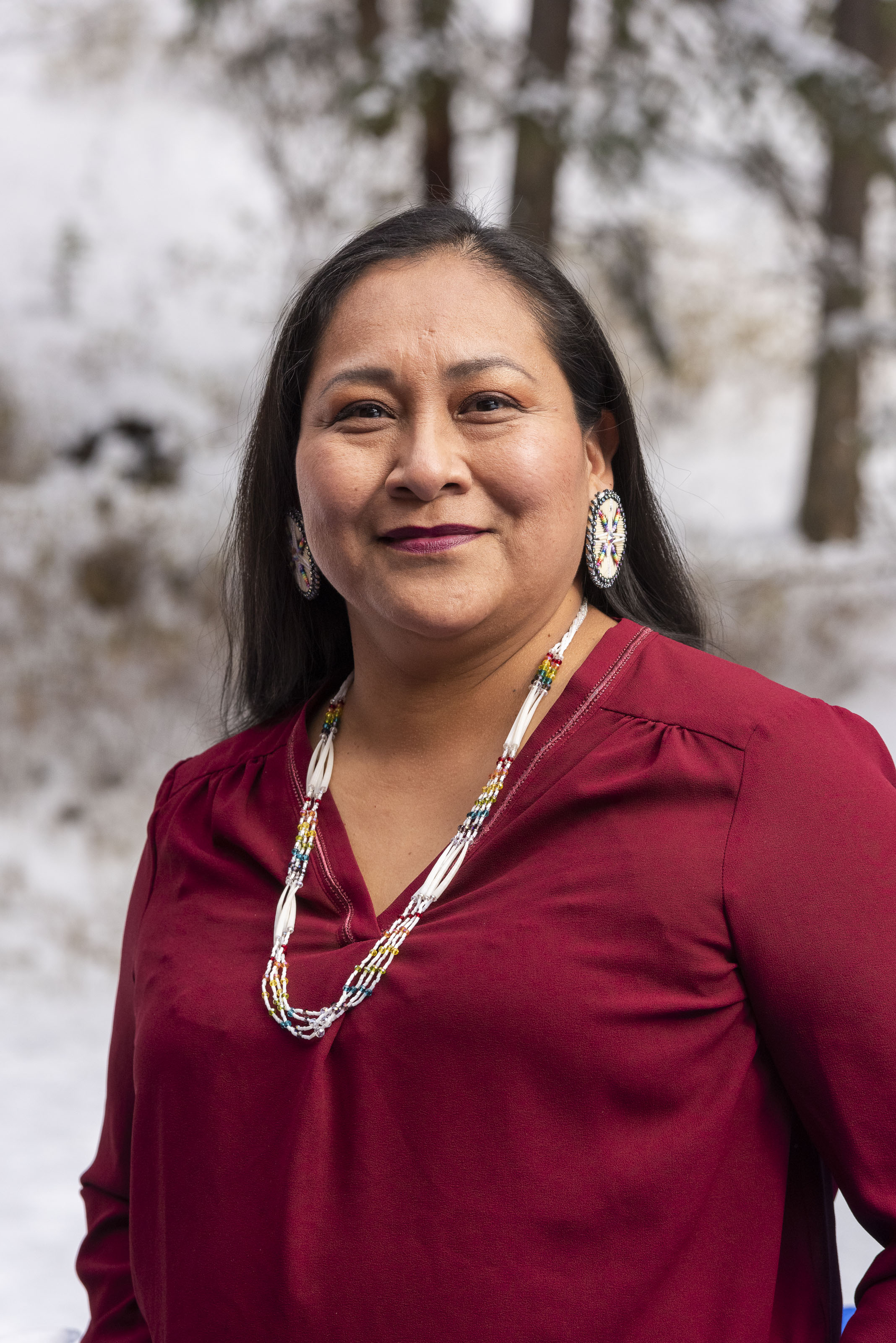 | A campus visit by Dr. Ranalda Tsosie, Assistant Professor at New Mexico Tech and Diné leader, provided a full day of opportunities for interdisciplinary engagement on Native American approaches to science for faculty, staff, and students. Thousands of Diné people living in the Tsétah area in northeastern Arizona and surrounding communities are suffering the effects of the legacy of uranium mining and lack of infrastructure, leading to widespread wellwater contamination by arsenic and uranium. Dr. Tsosie gave a presentation on a research framework including the six R’s of Indigenous research that incorporated the Diné indigenous approach with Western scientific approaches to identify solutions for water contamination issues. The event was moderated by the Initiative's Iris Stewart-Frey and undergraduate student Jessica Luna (Native American Coalition for Change) with a welcome by College of Arts and Sciences Dean Daniel Press. Following her presentation to over 150 in-person and online attendees were a reflection circle with students and faculty, a lunch with representatives from social justice units on campus, and an afternoon roundtable discussion on community-engaged innovation with engineering faculty in the Frugal Innovation Hub. The event was organized by the Initiative’s Water and Climate program, and sponsored by t the Native American Coalition for Change, the NorCal Network for Environmental Justice the Initiative co-leads, tUrn, the Inclusive Excellence Initiative, the Office for Diversity and Inclusion, and the Ignatian Center. |
Advancing Food Justice by Reducing Waste and Producing Worm Composting 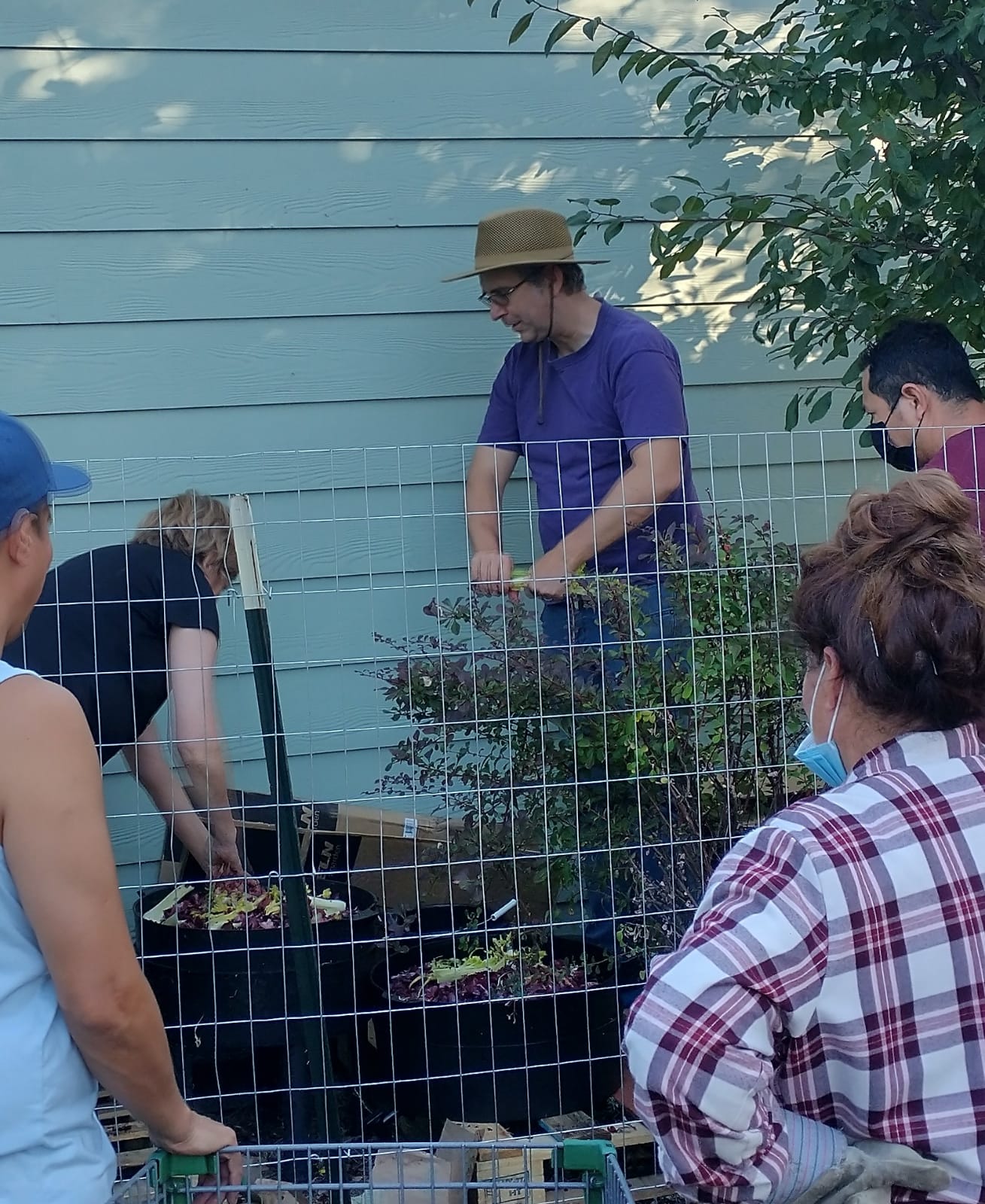 | Sacred Heart’s Essential Services and La Mesa Verde (LMV) programs are partnering with the Initiative’s Food and Climate Justice Program to advance food justice in the South Bay. The team led a workshop with LMV gardeners, food pantry staff, and volunteers to launch a composting pilot project. They invited Michele Young, a Master Composter with UC Extension and senior manager at the County of Santa Clara to offer technical training as part of a six-hour workshop that included building the pilot facility and hands-on worm composting. The SHCS Food Pantry serves 25,000 members each year. As part of an ongoing study, SCU Researchers have found that although the pantry recovers hundreds of thousands of pounds of edible food it also disposes of about 2,700 lbs per month (2-10% of the total food received). This project aims to transform the pantry’s food waste into compost while promoting the human right to food. The workshop was co-organized by the Initiative’s Christopher Bacon, Isabelle Solórzano (student researcher), and Fernando Fernandez Levia (SHCS manager). To learn more about free workshops on vermicomposting check UC Extensions Composting Education Program. |
|
Environmental Justice and the Common Good Initiative
Santa Clara University
500 El Camino Real
Santa Clara, CA 95053
environmentaljustice@scu.edu
|
|