
Effective Strategies for Courses
Santa Clara University is a globally diverse university with students residing in countries around the world engaging in online learning during pandemic. In developing pedagogical strategies for on-line learning, teaching across time zones can present significant logistical challenges. When should you schedule class meetings, exams, student collaborations when you and your students are spread across multiple time zones? The decisions faculty make about how to approach this can have a significant impact on pedagogical effectiveness and positive learning outcomes. Here are some tips and resources that may be helpful for managing the impact of time zones to create an effective teaching and learning environment.
Know the Time Zones of Students in Your Courses
For Fall 2020, 41% of SCU’s 1127 international students will be studying from outside the US. We will have students in 30 countries across 15 time zones spanning a 20 hour time difference. Awareness of time zones and tips will help in finalizing course delivery plans for student success.
To help you calibrate your course, you may wish to survey your students at the beginning of the class.
- Here are examples of questions to include in your survey:
- What time zone are you in? (in relation to GMT)
- Is there daylight saving time/does the time change, where you are?
- If yes, when does the time change begin? If yes, when does the time change end?
- What are the best hours/days to contact you taking into consideration time zone differences?
- Provide the names and dates of any holidays in your country (outside of the US) this term:
- Examples of common time zones of SCU students:
*Many countries do not observe Daylight Savings Time or change time zones on dates that differ from the US so the times below should be used as examples only. Communicate with students and refer to websites below for times that are accurate on particular dates.
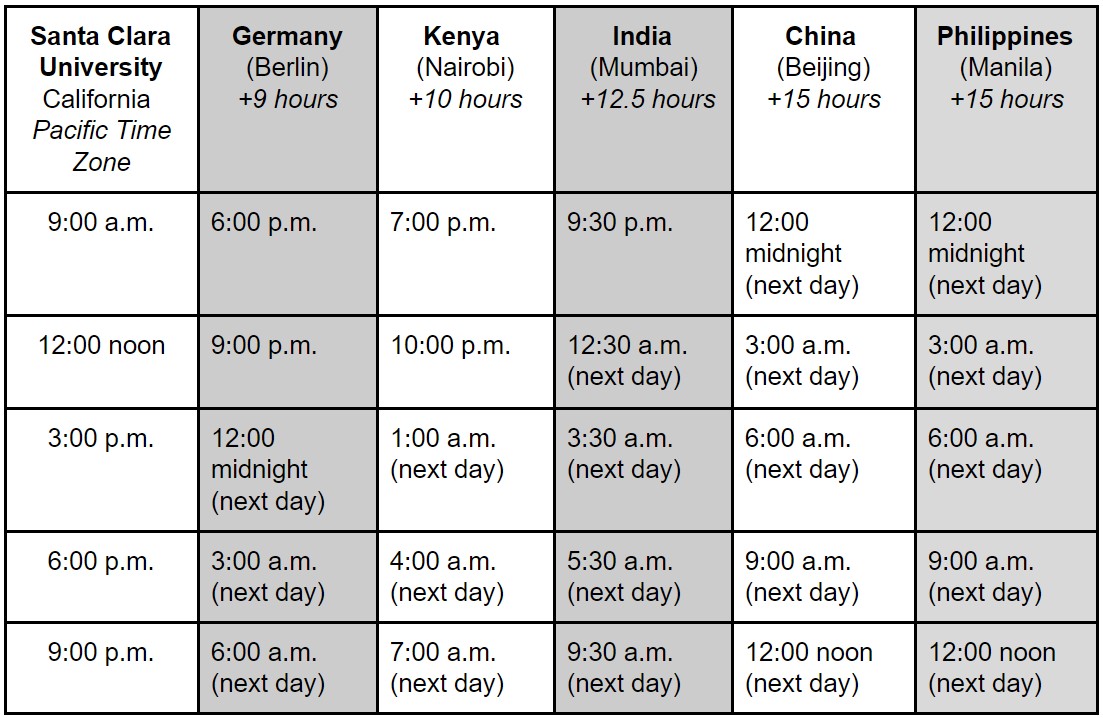
Helpful time zone planners:
The Weekend in Many Countries is Not Saturday/Sunday
In many countries Saturday and Sunday are not the weekend. In many Islamic countries the weekend may be either Thursday/Friday or Friday/Saturday. In Brunei, the weekend is Friday and Sunday and people work on Saturdays. In Nepal, Iran, Palestine, Somalia and Djibouti he weekend is officially only one day – Friday except in Nepal when it is Saturday.
Examples of countries of SCU students with Friday/Saturday weekends:
- Egypt
- Iran
- Israel
- Jordan
- Kuwait
- Malaysia
- United Arab Emirates
Holidays Around the World
Countries around the world observe different religious and cultural holidays. Surveying students at the beginning of class provides an opportunity for students to share holidays taking place during the term in their country.
Learn more about holidays around the world:
Tips for Effective Communication
Student learning online may be affected by time zones and scheduling if you require them to attend online sessions or complete work synchronously. Levels of attention, participation, energy, emotional or psychological issues, learning disabilities, or cognitive abilities may be of concern for students. To promote student success, faculty who teach online regularly recommend keeping synchronous lectures and discussions short and be mindful of overloading students with too much information and/or visual stimuli.
- Consider adopting a standard way of communicating about time, i.e., GMT or Pacific Time, to avoid confusion of “Are we meeting at 5:00 my time or your time?” “Are we meeting at 5:00 a.m. or p.m.? etc.
- Consider adopting a standard way of communicating about dates, e.g., writing out dates: Month, Day, Year, rather than 9/17/20 which can be confusing in cultures where day and month are reversed from the format in the US.
- Have resources available to disseminate to students about tech support
- Monitor student engagement and check comprehension, e.g., observe who is opening files, watching videos, accessing course materials and/or consider incorporating frequent quizzes to promote engagement.
How different cultures understand time
Cultures around the world view time differently and communicating clearly to students how time is viewed in the US – and how you view time related to courses – can help alleviate confusion. Cultural perspectives on time manifest themselves in manners that can be a source of confusion or conflict. Consider attitudes toward time in clock-capitol Switzerland versus Mexico.
Cultures tend to understand time as present-oriented (France), future-oriented (US, Japan), or past-oriented, (India). Recognize that, in the US we view time as money in our profit-oriented society, and, culturally, our attitudes about how to use time, punctuality, deadlines all flow from this perspective. Note that, of course, individuals may have unique approaches to cultural traits, but as a whole, some attitudes are generally shared by a culture.
Learn more about cultural perspectives on time: